When designing custom caps, choosing the right embroidery technique is just as important as selecting the cap style, fabric, colour, and logo. A well-designed logo can make an ordinary baseball cap look professional, stylish, and memorable. However, the embroidery method you choose can significantly influence the final appearance, texture, durability, and overall personality of your headwear.
Two of the most popular techniques in the custom headwear industry are 3D puff embroidery and flat embroidery. Both methods create attractive embroidered logos, but they offer different visual effects and are suitable for different types of designs.
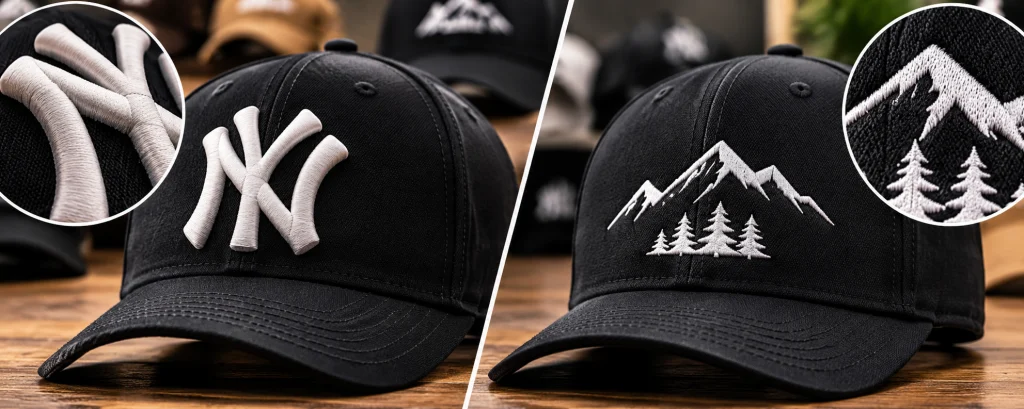
3D puff embroidery creates a raised, dimensional appearance by placing special foam underneath the embroidery stitches. It makes logos stand out from the surface of a cap, producing a bold and eye-catching finish. Flat embroidery, on the other hand, uses traditional stitching directly onto the cap fabric, creating a smooth, detailed, and professional appearance.
So, which technique is better for custom caps?
The answer depends on your logo, branding goals, preferred appearance, budget, and the type of cap you want to produce. Whether you are creating promotional merchandise, branded baseball caps, team headwear, or custom fashion accessories, understanding the differences between these two embroidery techniques can help you make the right decision.
In this guide, we will explore 3D puff embroidery vs flat embroidery, explain their benefits and limitations, compare their appearance and durability, and help you decide which embroidery method is best for your custom caps.
1. What Is 3D Puff Embroidery?
3D puff embroidery is a specialised embroidery technique that creates a raised, three-dimensional effect on the surface of a cap. Unlike traditional embroidery, where the thread sits relatively close to the fabric, this method uses a layer of embroidery foam underneath the stitching to lift the design.
The foam creates extra height and gives the logo a bold, textured appearance. It is particularly popular for custom snapback caps, baseball hats, streetwear headwear, and sports merchandise.
When customers see a cap with large raised lettering or a thick embroidered logo, there is a good chance it features 3D puff embroidery.
How Does 3D Puff Embroidery Work?
The production process involves several important steps:
Logo preparation: The original artwork is reviewed to determine whether it is suitable for raised embroidery.
Digitising: The design is converted into a specialised embroidery file that tells the machine how to stitch the logo.
Foam placement: A suitable layer of embroidery foam is placed over the selected area of the cap.
Embroidery stitching: The embroidery machine stitches over the foam using dense satin stitches.
Foam removal: Excess foam is carefully removed, leaving the foam beneath the stitching to create the raised effect.
Finishing: The embroidered area is inspected to ensure clean edges, consistent height, and proper thread coverage.
The result is a dimensional logo that adds depth and makes the design more noticeable.
Main Benefits of 3D Puff Embroidery
1. Eye-catching appearance
The biggest advantage of 3D puff embroidery is its visual impact. Raised lettering naturally attracts attention and makes the front of a cap look more distinctive.
2. Premium streetwear style
Many streetwear brands prefer raised embroidery because it gives their products a bold and fashionable appearance. It works particularly well with oversized lettering, initials, and strong brand symbols.
3. Excellent for bold logos
Large letters, simple graphics, numbers, and geometric shapes can look impressive when produced using 3D puff embroidery.
4. Adds texture and dimension
The raised surface creates a tactile experience. Customers can not only see the logo but also feel its texture.
5. Strong branding visibility
For businesses, sports clubs, and clothing brands, a raised front logo can help make branded caps more recognisable.
What Are the Limitations of 3D Puff Embroidery?
Although 3D puff embroidery offers an attractive finish, it is not suitable for every design.
Very small lettering can become difficult to read.
Thin lines may not provide enough coverage for the foam.
Intricate artwork can lose important details.
Tight spaces between letters can become filled or distorted.
It generally works best on structured caps with a firm front panel.
It requires specialised digitising and additional production steps.
For these reasons, businesses should evaluate their logo before choosing 3D puff embroidery. A design that looks excellent on a computer screen may need adjustments before it can be embroidered successfully.
2. What Is Flat Embroidery?
Flat embroidery is one of the most widely used techniques for decorating custom caps. It involves stitching thread directly onto the cap fabric without using foam underneath.
The embroidery machine follows a digitised design to create letters, shapes, symbols, and detailed artwork. Different stitch types are used to reproduce the original logo as accurately as possible.
Unlike 3D puff embroidery, flat embroidery creates a smooth finish that follows the surface of the cap.
This technique is ideal for companies that want a clean, professional, and versatile appearance.
How Does Flat Embroidery Work?
Flat embroidery also follows a carefully controlled production process.
Artwork selection: The customer’s logo or design is checked for clarity and embroidery suitability.
Digitising: The artwork is converted into a machine-readable embroidery file.
Cap preparation: The cap is positioned correctly in the embroidery machine.
Backing placement: Suitable stabilising material is used to support the fabric during stitching.
Thread application: The machine stitches the design directly onto the cap.
Quality inspection: The finished embroidery is checked for alignment, thread consistency, and overall appearance.
The finished design has a smooth, slightly textured surface that becomes part of the cap fabric.
Main Benefits of Flat Embroidery
1. Better for detailed logos
Flat embroidery is generally more suitable for artwork containing fine lines, smaller lettering, detailed symbols, and multiple design elements.
2. Clean and professional appearance
Businesses that prefer understated branding often choose flat embroidery because it delivers a refined and organised finish.
3. Flexible design options
It can be used for a wide variety of logos, including company names, school emblems, sports team badges, and promotional graphics.
4. Suitable for different cap styles
Flat embroidery can work on structured and unstructured caps, depending on the fabric, stabilisation, and design.
5. Ideal for smaller placements
It is particularly useful for side logos, rear embroidery, smaller front designs, and secondary branding elements.
6. Excellent for colour combinations
Multiple thread colours can be used to reproduce different sections of a logo, provided the artwork is suitable for the embroidery process.
What Are the Limitations of Flat Embroidery?
Flat embroidery is versatile, but it also has certain limitations.
It does not create the same raised appearance as 3D puff embroidery.
Extremely small details may still become difficult to reproduce.
Complex designs can require extensive digitising and stitching.
Large solid designs may become dense or heavy.
The finished appearance depends on fabric quality, thread selection, and embroidery settings.
Despite these limitations, flat embroidery remains an excellent option for businesses that prioritise detail, consistency, and professional branding.
3. 3D Puff Embroidery vs Flat Embroidery: Key Differences
Now that we understand both techniques, let’s compare them in detail.
The right choice depends on how you want your custom caps to look and what your logo requires.
| Comparison | 3D Puff Embroidery | Flat Embroidery |
|---|---|---|
| Appearance | Raised and dimensional | Smooth and traditional |
| Texture | Thick and elevated | Lightly textured |
| Best designs | Bold letters and simple logos | Detailed and complex logos |
| Small text | Generally unsuitable | More suitable |
| Fine details | Limited | Better detail reproduction |
| Cap structure | Structured fronts preferred | More versatile |
| Side embroidery | Less suitable | Excellent option |
| Streetwear style | Very popular | Clean and minimal |
| Production | Additional foam and finishing | Traditional stitching |
| Cost | Often higher | Often more economical |
Which Technique Looks More Premium?
Both embroidery techniques can produce premium-quality custom caps. However, they communicate different styles.
3D puff embroidery creates a bold appearance that is particularly attractive for streetwear brands, sports merchandise, and fashion-focused collections. Its raised texture makes a logo more prominent.
Flat embroidery creates a sophisticated appearance that works well for corporate merchandise, promotional products, uniforms, and minimalist fashion brands.
A premium result is not determined by embroidery height alone. The quality of the cap, stitching, thread, digitising, and finishing all contribute to the final product.
Which Technique Is Better for Logo Details?
If your logo includes small text, intricate shapes, thin outlines, or several design elements, flat embroidery is usually the better choice.
3D puff embroidery requires sufficiently wide shapes to cover the foam properly. When a design contains very narrow lines or tight spaces, the raised stitching may hide important details.
For example, a company logo featuring a large brand name with a small slogan underneath may look best with a combination of both techniques.
Which Technique Is More Suitable for Everyday Caps?
Flat embroidery is a versatile choice for everyday caps because it can be used across different styles and placements.
3D puff embroidery is a strong option when you want the front logo to become the main visual feature.
Neither technique is automatically more suitable for daily use. Proper stitching, quality materials, and appropriate care are important for both.
4. Which Custom Cap Styles Work Best With 3D Puff Embroidery?
The structure and construction of a cap can influence how embroidery looks after production. Certain cap styles provide better support for raised embroidery.
Here are some popular options.
1. Custom Snapback Caps
Snapback caps are among the most popular choices for 3D puff embroidery.
Their structured front panels provide a firm surface that helps support the foam and raised stitching. Their high-profile appearance also gives bold lettering enough room to stand out.
Brands can use puff embroidery for initials, short words, numbers, and distinctive symbols.
2. Custom Baseball Caps
Custom baseball caps offer excellent opportunities for both flat and 3D puff embroidery.
A structured baseball cap with a prominent front panel can showcase a raised logo beautifully. Flat embroidery is also suitable for detailed team logos and smaller branding.
These caps are widely used for promotional campaigns, sports teams, company merchandise, and casual fashion.
3. Custom Trucker Caps
Trucker caps combine a front fabric panel with mesh back panels.
The structured front provides a suitable location for bold puff embroidery, while the side or rear areas can be used for additional flat embroidery.
This combination makes trucker caps a popular option for outdoor brands, lifestyle businesses, and casual clothing labels.
4. Custom Five-Panel Caps
Five-panel caps are popular in contemporary streetwear and casual fashion.
Their front construction can provide a clean canvas for larger embroidered logos. Depending on the fabric and front-panel structure, they can be suitable for 3D puff embroidery.
The absence of a traditional centre seam on many five-panel designs can also make logo placement easier.
5. Custom Six-Panel Caps
Six-panel caps are classic headwear options used by businesses, teams, and fashion brands.
They can feature flat or raised embroidery, although the front centre seam needs careful consideration during digitising and placement.
For designs crossing the seam, a production sample is particularly helpful.
5. Which Custom Cap Styles Work Best With Flat Embroidery?
Flat embroidery works across a wider variety of cap styles because it does not rely on foam to create its appearance.
Here are some excellent options.
1. Custom Dad Hats
Dad hats generally have a relaxed, unstructured design.
Their soft front panels make them particularly suitable for flat embroidery, especially when the logo is small or minimalist.
Brands often use embroidered initials, short brand names, and simple symbols to create a casual appearance.
2. Custom Washed Caps
Washed caps are popular for vintage-inspired fashion and everyday styling.
Flat embroidery complements their relaxed appearance without adding excessive height or stiffness to the front panel.
Contrasting thread colours can also make small logos more visible.
3. Custom Corporate Caps
Companies often need headwear that looks professional and represents their identity clearly.
Flat embroidery is suitable for company logos, business names, and smaller promotional designs.
It works particularly well when the objective is to create branded merchandise that employees and customers can wear regularly.
4. Custom Sports Caps
Sports teams often use flat embroidery for detailed crests, team emblems, and secondary branding.
It provides flexibility for designs featuring several colours and smaller graphic elements.
5. Custom Bucket Hats
Bucket hats offer a different approach to personalised headwear.
Flat embroidery can be applied to selected areas of the crown or brim, depending on the construction and available embroidery space.
Small logos and simple branding often work particularly well on these hats.
6. Can You Combine 3D Puff and Flat Embroidery on One Cap?
Absolutely! Combining 3D puff and flat embroidery is one of the most effective ways to create distinctive custom caps.
This technique is often called hybrid embroidery because it uses both methods within one design.
Instead of choosing between a raised appearance and fine detail, you can use each technique where it works best.
How Does Hybrid Embroidery Work?
For example, imagine a company logo containing:
Large brand initials.
A small company name.
A decorative border.
A short slogan.
The large initials can be created using 3D puff embroidery, while the smaller text and decorative elements can be stitched using flat embroidery.
This produces a balanced design with visual depth and clear details.
Popular Hybrid Embroidery Ideas
Raised initials with flat company name: Ideal for fashion brands and corporate merchandise.
3D puff lettering with flat outlines: Creates a more defined appearance around the raised letters.
Raised team name with flat sports emblem: A popular approach for athletic and club headwear.
Puff logo with flat side embroidery: Adds additional branding without making the entire cap look overcrowded.
Why Should Businesses Consider Hybrid Embroidery?
Hybrid embroidery allows brands to create more customised designs without compromising important logo details.
It can help:
Improve logo visibility.
Create visual contrast.
Highlight important branding elements.
Maintain readability of smaller text.
Give caps a distinctive appearance.
However, combining techniques requires careful digitising and stitch sequencing. A sample should be reviewed before approving bulk production.
7. Which Embroidery Technique Is More Durable?
Durability is an important consideration when ordering custom embroidered caps, especially for businesses purchasing merchandise in larger quantities.
Both flat and 3D puff embroidery can offer long-lasting results when produced correctly.
However, their construction is different.
Flat Embroidery Durability
Flat embroidery stitches directly into the fabric and uses suitable backing to stabilise the material.
When properly manufactured, the stitches can remain secure through regular wear and normal care.
Because there is no foam underneath, there is no raised foam layer that can become exposed through wear.
3D Puff Embroidery Durability
3D puff embroidery also uses strong stitching, but its raised construction requires proper edge coverage and careful finishing.
The foam underneath creates the dimensional effect, while dense stitches hold the design in place.
If the artwork is not properly digitised or the foam is not covered correctly, the design may develop visible imperfections.
How to Make Embroidered Caps Last Longer
Regardless of the embroidery technique, these care tips can help maintain the appearance of your caps:
Follow the care instructions supplied with the cap.
Avoid excessive rubbing against the embroidered logo.
Do not pull loose threads.
Use gentle cleaning methods appropriate for the fabric.
Avoid high-temperature washing or drying unless the care label permits it.
Store caps in a way that protects their shape.
Avoid crushing raised embroidery during storage.
The overall lifespan depends on thread quality, cap construction, stitching, usage, and maintenance.
8. Is 3D Puff Embroidery More Expensive Than Flat Embroidery?
Pricing is another important factor when choosing embroidery for custom caps.
Generally, 3D puff embroidery can cost more than flat embroidery because it involves additional materials and production steps.
However, the actual price depends on the design and manufacturing requirements.
Factors That Influence Embroidery Costs
1. Stitch count
The number of stitches required to complete a logo is one of the important factors affecting embroidery costs.
A detailed flat design can sometimes require more stitches than a relatively simple raised logo.
2. Logo size
Larger embroidery designs generally require more materials and production time.
3. Number of colours
Using multiple thread colours can increase machine changeovers and production complexity.
4. Digitising requirements
Both techniques require suitable digitising. 3D puff designs often need additional adjustments to stitch density, satin columns, and edge coverage.
5. Foam requirements
3D puff embroidery requires foam material, which adds to the production cost.
6. Order quantity
The quantity of caps can influence the final price per unit because setup costs and production time are distributed across the order.
Which Is Better for Bulk Orders?
Flat embroidery is often an economical option for companies ordering large quantities of caps with detailed logos.
3D puff embroidery can be worth the additional expense when the brand needs a bold, raised appearance.
The best approach is to compare the finished appearance and production cost rather than selecting a technique based on price alone.
9. How to Choose the Right Embroidery Technique for Your Brand
Choosing between 3D puff and flat embroidery becomes easier when you understand your brand identity and the purpose of your caps.
Here are some practical recommendations for different types of businesses.
Clothing and Streetwear Brands
If you operate a streetwear or fashion brand, 3D puff embroidery can be an excellent choice.
Raised lettering creates a distinctive appearance and gives your products a fashionable, retail-ready finish.
It is particularly suitable for:
Oversized brand initials.
Bold typography.
Minimalist symbols.
Sports-inspired graphics.
Statement snapback caps.
For smaller branding elements, flat embroidery can provide a complementary finish.
Small Businesses and Startups
Small businesses often use custom caps to increase brand recognition and promote their services.
Flat embroidery is a practical choice when your logo contains a business name, detailed symbol, or multiple colours.
For businesses with a simple and bold logo, 3D puff embroidery can help create more noticeable promotional merchandise.
Sports Teams and Clubs
Sports teams frequently use embroidered caps to create a consistent team identity.
3D puff embroidery is excellent for large team initials, player numbers, and bold lettering. Flat embroidery works well for detailed team badges and smaller supporting graphics.
A combination of both techniques can produce professional-looking team merchandise.
Corporate Businesses
Companies looking for professional uniforms and promotional merchandise may prefer flat embroidery.
It provides a clean finish that works well with business logos, employee uniforms, and branded accessories.
For special events, product launches, and promotional campaigns, raised embroidery can provide a more distinctive appearance.
Promotional Merchandise Companies
Promotional merchandise needs to balance appearance, quality, and cost.
Flat embroidery is suitable for a wide range of promotional designs, while 3D puff can help make selected products stand out.
The right decision depends on the target audience, order quantity, and intended use of the caps.
10. Best Thread Colours for 3D Puff and Flat Embroidery
Thread colour selection plays a major role in the appearance of embroidered custom caps.
Even an excellent logo can lose its impact if the thread colour does not complement the cap fabric.
Both embroidery techniques offer different creative opportunities.
Popular Colour Combinations for 3D Puff Embroidery
Some popular combinations include:
| Cap Colour | Embroidery Colour | Overall Style |
|---|---|---|
| Black | White | Bold and modern |
| Navy Blue | White | Classic and sporty |
| White | Black | Clean and minimal |
| Olive Green | Cream | Outdoor-inspired |
| Maroon | White | Distinctive and stylish |
| Grey | Black | Contemporary |
| Royal Blue | Yellow | Sporty and energetic |
These combinations work particularly well when the logo has thick lettering and simple shapes.
Popular Colour Combinations for Flat Embroidery
Flat embroidery provides excellent flexibility for detailed colour combinations.
Popular choices include:
Black caps with white logos.
Beige caps with dark brown embroidery.
Navy caps with red and white branding.
Grey caps with black or white stitching.
White caps with colourful company logos.
Khaki caps with cream or dark green embroidery.
For a professional appearance, consider using colours that match your existing brand identity.
11. Common Mistakes to Avoid When Ordering Custom Embroidered Caps
Selecting the correct embroidery technique is important, but several other factors can influence the final quality of your custom headwear.
Avoiding these common mistakes can help you achieve better results.
Mistake 1: Choosing 3D Puff for Every Logo
Not every logo is suitable for raised embroidery.
Thin lettering, complicated artwork, and intricate symbols may not reproduce properly with foam underneath.
Better approach: Review the original logo and identify which parts can support raised stitching.
Mistake 2: Ignoring Cap Structure
A soft and unstructured cap may not provide enough support for a large 3D puff logo.
The fabric can distort when the foam and dense stitching are applied.
Better approach: Choose a structured cap with a supportive front panel when raised embroidery is your priority.
Mistake 3: Using Very Small Text
Small text can become difficult to read with 3D puff embroidery because the foam and dense stitches can close narrow spaces.
Better approach: Use flat embroidery for small text and supporting details.
Mistake 4: Selecting Poor Colour Combinations
Low contrast between the thread and cap fabric can make an embroidered logo difficult to notice.
Better approach: Select thread colours that complement the cap and provide sufficient contrast.
Mistake 5: Skipping the Sample Approval Process
A digital design preview cannot show every detail of the actual embroidered product.
The final appearance may vary depending on the cap fabric, stitching, foam thickness, and embroidery placement.
Better approach: Request a physical sample or embroidery sew-out where appropriate before approving a large order.
Mistake 6: Ignoring Logo Placement
The front, side, and back panels of a cap have different shapes and available embroidery areas.
A design that looks excellent on the front may not fit properly on a smaller side panel.
Better approach: Decide the embroidery placement before finalising the artwork.
Mistake 7: Choosing Price Over Quality
The cheapest option may not provide the stitching quality, materials, or finishing your brand requires.
Better approach: Consider the complete product, including cap fabric, thread quality, construction, and embroidery finishing.
12. How to Prepare Your Logo for Custom Cap Embroidery
Before placing an order for custom embroidered caps, it is important to prepare your logo correctly.
Good artwork preparation helps the digitising and production teams achieve a more accurate result.
Provide a High-Quality Logo File
Whenever possible, supply a vector file such as AI, EPS, or SVG.
A high-resolution PNG can also be useful for reviewing the design.
Vector artwork is particularly helpful because it can be resized without losing image quality.
Simplify Complicated Artwork
If your logo contains many small details, consider simplifying certain elements.
This is especially important for 3D puff embroidery, where thick shapes and clear spacing are essential.
Select Suitable Lettering
Bold fonts and block lettering generally work well for raised embroidery.
For flat embroidery, more detailed lettering can be considered, provided it remains readable at the final embroidery size.
Choose Appropriate Thread Colours
Provide your brand’s preferred thread colours or reference colour codes where available.
Remember that thread appearance can vary slightly from digital screen colours.
Confirm the Final Embroidery Size
The embroidery size should be appropriate for the cap panel and the complexity of the logo.
A design should be checked at its actual production size, not just enlarged on a computer screen.
Review the Digitised Design
Before production, review the digitised embroidery artwork and any available sew-out.
Check lettering, spacing, outlines, colours, and placement to ensure the design represents your brand correctly.
13. Why Custom Embroidered Caps Are a Smart Investment for Businesses
Custom embroidered caps are more than fashion accessories. They can also become valuable branding tools for businesses of different sizes.
Whether you operate a clothing company, restaurant, construction business, sports organisation, or promotional merchandise company, branded headwear offers several marketing opportunities.
Builds Brand Recognition
A cap featuring your company logo can help people become familiar with your brand.
Employees, customers, and event participants can wear branded headwear in different settings, creating additional exposure.
Creates Professional Team Uniforms
Matching embroidered caps help businesses create a consistent appearance among their employees.
Restaurants, retail stores, delivery companies, and outdoor service providers can all benefit from coordinated headwear.
Supports Marketing Campaigns
Custom caps can be distributed at exhibitions, trade shows, product launches, sporting events, and promotional campaigns.
A well-designed cap is a useful promotional item that customers may continue wearing after the event.
Offers Fashion and Functionality
Unlike some promotional products, caps serve a practical purpose while also functioning as fashion accessories.
Customers can wear them for everyday activities, outdoor events, travel, and casual occasions.
Provides Flexible Branding Options
Businesses can customise their caps with different:
Colours and fabrics.
Embroidery techniques.
Logo placements.
Cap styles.
Thread combinations.
Adjustable closures.
Branding details.
This flexibility makes custom caps suitable for different industries and audiences.
14. How to Maintain the Quality of Your Custom Embroidered Caps
Once you have invested in custom headwear, proper maintenance can help preserve its appearance.
Here are some useful tips.
Clean carefully: Use a gentle cleaning method suitable for the cap’s fabric and follow the manufacturer’s care instructions.
Avoid harsh chemicals: Strong detergents and bleach can affect fabric and thread colours.
Protect the embroidered logo: Avoid aggressive scrubbing or pulling at the stitching.
Maintain the cap’s shape: Store caps in a way that prevents the crown from becoming crushed.
Be careful with raised embroidery: Do not press heavy objects directly against a 3D puff logo.
Dry appropriately: Follow the cap’s care label and avoid excessive heat.
Regular care can help keep both flat and raised embroidery looking attractive for longer.
15. Why Choose USA Custom Caps for Your Custom Headwear?
When ordering custom caps, selecting the right supplier is just as important as choosing the embroidery technique.
You need a provider that understands different cap styles, embroidery requirements, logo placement, and the importance of consistent product quality.
At USA Custom Caps, the focus is on helping customers explore custom headwear options that suit their branding and design requirements.
Whether you are developing branded merchandise for a business, creating headwear for a sports team, or building a clothing collection, selecting the right combination of cap style and embroidery can make a significant difference.
Customisation Options to Consider
When planning your custom cap order, consider the following features:
Custom baseball caps.
Custom snapback caps.
Custom trucker hats.
Custom five-panel caps.
Custom six-panel caps.
Custom embroidered caps.
Different fabric and colour options.
Personalised logo placement.
Flat and raised embroidery styles, where available.
Create Headwear That Represents Your Brand
Your cap should reflect your brand’s personality.
A raised 3D puff logo can create a bold streetwear appearance, while flat embroidery can deliver a refined and professional finish.
The most important thing is selecting a design that looks attractive, remains readable, and works well with the construction of your chosen cap.
Frequently Asked Questions (FAQs)
1. What is the main difference between 3D puff embroidery and flat embroidery?
The main difference is their appearance and construction. 3D puff embroidery uses foam underneath the stitches to create a raised design, while flat embroidery stitches directly onto the cap fabric to produce a smooth finish.
2. Is 3D puff embroidery better than flat embroidery?
Neither technique is universally better. 3D puff is ideal for bold lettering and simple logos, while flat embroidery is generally better for detailed artwork, small text, and intricate designs.
3. Does 3D puff embroidery last longer than flat embroidery?
Not necessarily. Both techniques can be durable when properly manufactured. Their longevity depends on stitch quality, thread, materials, cap construction, and care.
4. Can any logo be converted into 3D puff embroidery?
No. Logos containing thin lines, small lettering, and complicated details may not work well with raised embroidery. Some designs need to be simplified or partially converted to flat embroidery.
5. Is 3D puff embroidery suitable for snapback caps?
Yes. Structured snapback caps are among the most popular options for 3D puff embroidery because their front panels provide support for the raised design.
6. Can flat embroidery be used on dad hats?
Yes. Flat embroidery is particularly suitable for dad hats because it works well with their relaxed and unstructured construction.
7. Can I combine flat and 3D puff embroidery?
Yes. Hybrid embroidery combines both techniques in one design. For example, you can use raised embroidery for large initials and flat embroidery for smaller text and decorative details.
8. Is flat embroidery cheaper than 3D puff embroidery?
Flat embroidery is often more economical because it does not require additional foam and the same specialised raised stitching process. However, the final price depends on stitch count, design complexity, cap style, and order quantity.
9. Which embroidery technique is best for company logos?
Flat embroidery is generally a good choice for detailed company logos and smaller lettering. However, companies with bold and simple branding may prefer 3D puff embroidery for a more prominent appearance.
10. Can 3D puff embroidery be used on trucker hats?
Yes. Trucker hats with structured front panels are suitable candidates for 3D puff embroidery. The mesh back is generally not the preferred location for this technique.
11. Does 3D puff embroidery require special digitising?
Yes. A puff design requires specific stitch planning, including suitable satin columns, density, and edge coverage. An ordinary flat embroidery file should not simply be reused without adjustments.
12. How do I choose the right embroidery for my custom caps?
Start by reviewing your logo, preferred appearance, cap structure, and budget. Choose 3D puff for bold raised designs, flat embroidery for detailed logos, or a combination when your artwork needs both effects.
Conclusion: Which Embroidery Technique Should You Choose?
Choosing between 3D puff embroidery and flat embroidery depends on your design requirements and branding goals.
Both techniques offer excellent opportunities to create attractive and professional custom caps, but each has its own strengths.
3D puff embroidery is an excellent choice for brands that want bold, raised lettering and eye-catching designs. It works particularly well on structured snapbacks, baseball caps, and trucker hats.
Flat embroidery is ideal for detailed logos, smaller text, corporate branding, and minimalist designs. Its smooth appearance and versatility make it suitable for a wide range of headwear styles.
If you want the best of both techniques, hybrid embroidery allows you to combine raised lettering with detailed flat stitching.
Our recommendation: Don’t choose an embroidery technique simply because it is popular. Choose the one that complements your logo, cap construction, and brand identity.
A carefully designed and professionally embroidered cap can become a valuable part of your brand’s identity, helping your business stand out while giving customers a product they will enjoy wearing.
Explore your options with USA Custom Caps and create custom headwear that brings your ideas to life.